
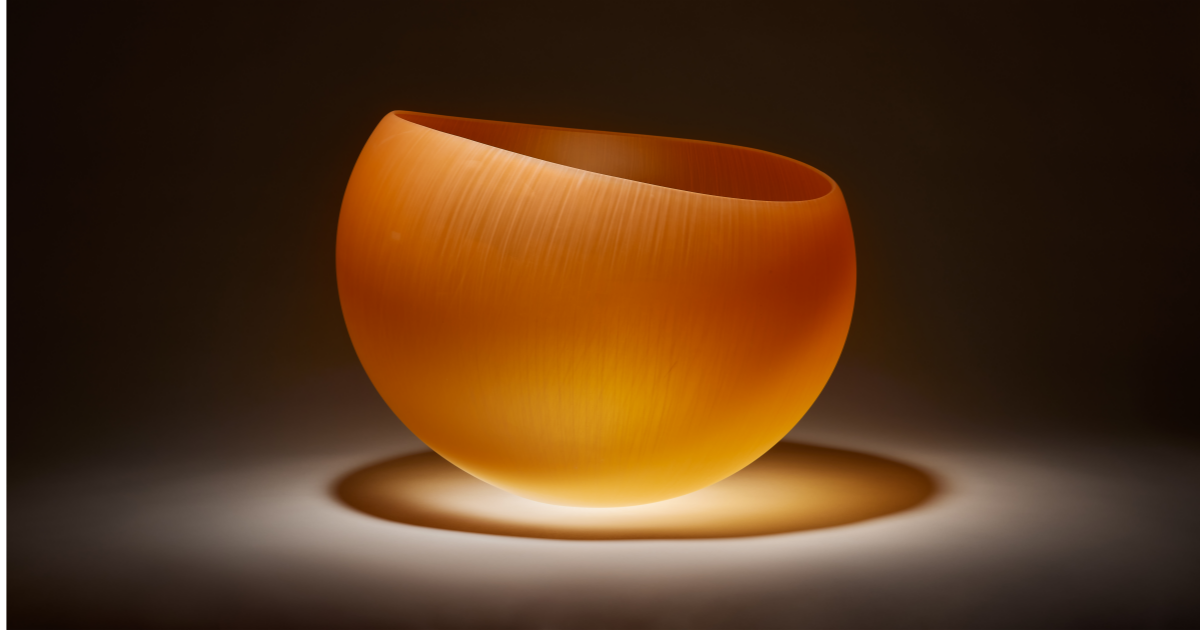
In a studio outside Seoul, behind a steel door and a thick curtain of canvas, two furnaces burn at 1,200°C. A small bench faces them. On the bench, a row of metal tools — jacks, blocks, paddles, shears, marvers — sit within reach of a left hand and a right hand. The right hand turns a long steel pipe slowly. The pipe ends in a soft, glowing gather of molten glass. The artist puts the other end of the pipe to his mouth, breathes once, and the gather extends. He breathes again. The gather extends further. He sits down at the bench, sets the pipe on a rail, and begins to turn it, evenly, while a colleague brings a thin coloured rod and lays it across the surface of the gather. The rod softens, fuses, and stretches into a single fine line. The line begins to wrap around the form. Twelve hours of this constitute one normal working day for Lee Taehoon.서울 외곽의 한 스튜디오, 두꺼운 캔버스 막을 친 강철 문 안쪽에서 두 대의 가마가 1,200°C로 타오릅니다. 그 앞에는 작은 작업 벤치가 놓여 있습니다. 벤치 위에는 한쪽 손이 닿는 거리에 금속 도구들이 일렬로 놓여 있습니다 — 잭(jacks), 블록, 패들, 가위, 마버. 오른손은 긴 강철 파이프를 천천히 돌립니다. 파이프 끝에는 부드럽게 빛나는 용융 유리 덩어리가 매달려 있습니다. 작가는 파이프의 반대쪽 끝을 입에 대고 한 번 숨을 불어넣습니다. 덩어리가 늘어납니다. 다시 한 번 숨을 불어넣습니다. 덩어리는 한층 더 늘어납니다. 그는 벤치에 앉아 파이프를 레일에 올려놓고 일정한 속도로 굴리기 시작하고, 동료가 가느다란 색유리 막대를 가져와 덩어리의 표면 위에 얹습니다. 막대는 부드러워지면서 덩어리에 녹아들고, 한 줄의 가느다란 선으로 늘어납니다. 그 선은 형태를 따라 감기기 시작합니다. 이태훈에게 이런 작업은 평소 하루 12시간의 일과입니다.ソウル郊外の工房、分厚いキャンバスの幕の奥にある鉄扉の向こうで、二基の炉が1,200°Cで燃え続けています。その前に小さな作業ベンチが据えられ、片手の届く範囲に金属の道具がきれいに並んでいます — ジャック、ブロック、パドル、はさみ、マーヴァー。右手は長い鉄のパイプをゆっくり回しています。パイプの先には、やわらかく光る溶融硝子の塊。作家はパイプの反対の端を口にあて、一度息を吹き込みます。塊はすこし伸びます。もう一度息を吹き込みます。塊はさらに伸びていきます。ベンチに腰を下ろし、パイプをレールに置き、一定の速さで回しはじめると、共作の仲間が細い色硝子の棒を運んできて、塊の表面に静かにのせます。棒はやわらかくなって塊に溶け込み、一本の細い線へと伸びていきます。その線は、かたちを巻き取るようにまわり始めます。イ・テフンさんにとって、こうした作業がふだんの一日12時間の仕事です。
Lee Taehoon entered glass through university. He wanted to study the material, took up blowing in his first year, and discovered very quickly that the technique was harder than he had imagined. The accepted wisdom around him was to treat the material loosely and concentrate on concept — let the surface decide. He went the other way. From his third year he worked twelve hours a day in the school facility, took the position of facility manager so that he could stay later than other students, and learned every furnace, bench, and tool by watching seniors and visiting Japanese teachers. When he set up his own studio in Seoul, he built the furnaces and benches himself; he ran the gas lines and the electrics; he assembled the ventilation. The studio is one of the few in Korea whose principal artist has personally welded the equipment he works on.이태훈은 유리를 대학에서 만났습니다. 재료 자체를 공부하고 싶어 입학했고, 1학년 때 블로잉을 배웠으며, 이 기법이 자신이 짐작했던 것보다 훨씬 어렵다는 사실을 곧 깨달았습니다. 주변의 보편적 충고는 ‘재료에는 너무 매달리지 말고 콘셉트에 집중하라’는 것이었습니다 — 표면이 결정하게 두라는 것이지요. 그는 반대의 길을 택했습니다. 3학년 때부터 학교 시설을 관리하는 자리를 맡아, 다른 학생들보다 더 늦은 시간까지 학교에 남을 수 있게 했습니다. 매일 12시간을 작업장에 머물면서 선배와 교수, 그리고 일본에서 온 선생들의 작업을 곁에서 보며 가마와 벤치, 도구의 쓰임을 차곡차곡 익혔습니다. 서울에 자신의 스튜디오를 차렸을 때, 그는 가마와 벤치를 직접 만들었습니다. 가스 배관과 전기 배선을 손수 깔고, 환기 시스템을 직접 조립했습니다. 한국에서 작가 본인이 설비를 손수 용접하여 쓰는, 매우 드문 스튜디오 가운데 하나입니다.イ・テフンさんが硝子と出会ったのは、大学でのことでした。素材そのものを学びたくて入学し、一年次にブロウイングを覚えました。そして、この技法が思い描いていたよりずっと難しい、ということをすぐに知ります。まわりの助言はおおむね、「素材に深入りせず、コンセプトに集中したほうがいい」というものでした — 表面に任せなさい、と。けれど、彼は反対の道を選びました。三年次から学内の施設管理を引き受け、ほかの学生より長く工房に残れるようにします。毎日12時間を工房で過ごし、先輩や教授、日本から来た先生の手仕事を間近で見ながら、炉、ベンチ、道具のひとつひとつを身につけていきました。ソウルに自分の工房を構えたとき、彼は炉とベンチをみずから組み上げています。ガス管も電気配線も、換気のしくみも、自分の手で整えました。韓国でも、作家自身が設備を溶接して使う、ごくわずかな工房のひとつです。
It is not complete until it is complete. Every time you open the kiln, every time you finish a piece, it can shatter.완성이 될 때까지는 완성이 아닙니다. 가마 문을 열 때마다, 마감 작업이 끝날 때마다, 작품은 깨질 수 있습니다.完成になるまでは、完成ではありません。炉の扉を開けるたび、後加工が終わるたび、作品は割れていきます。
For a long stretch of years Lee Taehoon’s vocabulary was the line. He had taken the visual cue from dandelion seeds — the dense radial fineness of a single seed-head — and built a body of work around a tightly woven grid: horizontal and vertical filaments of colour, laid into the glass at right angles, the way a weaver lays warp and weft. Each work was an exercise in the discipline of regularity. The eye read it as fabric rather than as glass. He came to feel, after several years, that the grid had told him what it could tell him. He wanted to change.오랜 시간 동안 이태훈의 어휘는 ‘선’이었습니다. 그는 민들레 홀씨에서 시각적 단서를 얻었습니다 — 한 송이의 홀씨가 가지는, 빽빽하고 가느다란 방사형의 결을. 그 결을 가로와 세로의 색유리 선으로 옮기고, 직조하듯 직각으로 짜 넣어 한 시기의 작업을 구축했습니다. 각각의 작품은 규칙성의 훈련이었고, 눈은 그 표면을 유리가 아니라 직물(織物)로 읽게 됩니다. 몇 해를 지내며, 그는 이 격자(格子)가 자신에게 들려줄 이야기를 다 들려주었다고 느꼈습니다. 변화가 필요했습니다.長いあいだ、イ・テフンさんの語彙は「線」でした。たんぽぽの綿毛から手がかりを得て — ひとつの綿毛が抱えている、密でこまかな放射の形を — 横と縦の色硝子の線へと写し、織り手が経(たて)と緯(よこ)を組むように直角で編み込んだ作品群を、一時期つくり続けました。それぞれの作品は規則性の訓練であり、眼はその表面を、硝子ではなく一枚の織物として読みます。けれど数年が過ぎて、彼はこの格子から聞くべき声をすでに聞き終えたと感じます。変化が必要でした。
In March 2024 he travelled to Jingdezhen, the Chinese city historically famous for porcelain, for a three-month residency. He had time and silence. He wandered the city to think; the weather changed minute to minute. Rain. Bright sun. Rain again. He noticed how the colour of the sky kept changing — mornings, sunsets, the city lit at night, the shifting irregular geometry of passing clouds. He began to photograph the sky and store the images. The visual cue stopped being a seed and started being a cloud. Where the dandelion had asked for grids of straight lines, the cloud asked for tangled, drifting, soft-edged lines — lines that read tightly from a distance and irregularly close up. The two pieces shown at Design Miami Seoul in September 2025 are early proofs from this new direction. A Red Cloud in the Sky and A Cloudy Sky (Ruby Purple) retain the cane discipline that runs through all his work, but the lines no longer cross at right angles. They drift. In his own words on this body of work, ‘the line is no longer a structural element — it is an entity that changes and moves like nature itself.’2025년 9월 디자인 마이애미 서울에서 공개한 두 작품은 이 새로운 방향의 초기 증거입니다. A Red Cloud in the Sky와 A Cloudy Sky (Ruby Purple)은 그의 모든 작업을 관통하는 케인의 규율을 유지하지만, 선들은 더 이상 직각으로 만나지 않습니다. 그 선들은 흘러갑니다. 그 자신의 말을 빌리면, 이 시기의 선은 ‘구조적 요소가 아니라 자연처럼 변화하고 이동하는 존재’입니다.2025年9月、デザイン・マイアミ・ソウルで発表された二作は、この新しい方向のはやい段階の証です。《A Red Cloud in the Sky》と《A Cloudy Sky (Ruby Purple)》は、彼の作業を貫くケインの規律を保ちながらも、もはや直角で交わりません。線は、流れていきます。本人の言葉を借りれば、この時期の線は「構造的な要素ではなく、自然そのもののように変化し、移ろう存在」です。
A second movement is already underway. The series he has begun in 2025, Dreamscape, takes the night sky and the trajectories of stars as its visual cue. In his artist statement on this work he writes that the act of layering countless lines into a single mass, then blowing, carving, and polishing it, is ‘akin to organising a turbulent mind and disciplining oneself.’ The work, he says, ‘records a process of emptying the self, reconciling with nature, and finding a centre from a state of absence.’ In the bottle he is making with us, both languages — the cloud and the dreamscape — will be present at once.2024년 3월, 그는 도자기로 유명한 중국 징더전(景德鎭)에서 석 달의 레지던시를 보냈습니다. 시간과 침묵이 주어졌습니다. 그는 생각을 정리하기 위해 도시를 걸어 다녔고, 날씨는 시시각각 바뀌었습니다. 비가 쏟아졌다, 햇살이 쨍쨍했다, 다시 비. 그는 하늘의 색이 끊임없이 바뀌는 모습 — 아침과 일몰, 조명을 받은 밤의 도시, 지나가는 구름의 비정형적인 기하학 — 을 알아채기 시작했습니다. 그는 하늘을 사진으로 찍어 모으기 시작했습니다. 시각적 단서가 더는 홀씨가 아니라 구름이 되었습니다. 민들레가 일정한 직선의 격자를 요구했다면, 구름은 얽히고 흘러가는, 가장자리가 부드러운 선을 요구했습니다 — 멀리서는 빽빽하게 보이고 가까이서는 불규칙해 보이는 선들을. 2025년 9월 디자인 마이애미 서울에서 공개한 두 작품은 이 새로운 방향의 초기 증거입니다. A Red Cloud in the Sky와 A Cloudy Sky (Ruby Purple)은 그의 모든 작업을 관통하는 케인의 규율을 유지하지만, 선들은 더 이상 직각으로 만나지 않습니다. 그 선들은 흘러갑니다.2024年3月、彼は陶磁器の都として知られる中国・景徳鎮で3か月のレジデンシーを過ごします。時間と静けさが手元にありました。考えを整えるために街を歩きまわるあいだ、天気は刻々と変わります。土砂降り、強い日差し、また雨。空の色が止まずに変わっていくこと — 朝と日の暮れ、灯のともった夜の街並、流れる雲のいびつな幾何 — を、彼はだんだんと意識するようになりました。空を撮りためはじめます。手がかりは、もう綿毛ではなく雲になっていきました。たんぽぽが直線の格子を求めたとすれば、雲は絡みあいながら流れる、輪郭のやわらかい線を求めます — 遠目には密に、近づくといびつに見える線を。2025年9月、デザイン・マイアミ・ソウルで発表された二作は、この新しい方向のはやい段階の証です。《A Red Cloud in the Sky》と《A Cloudy Sky (Ruby Purple)》は、彼の作業を貫くケインの規律を保ちながらも、もはや直角で交わりません。線は、流れていきます。
The technique Lee Taehoon uses is not Korean in origin. It begins in 16th-century Venice, on the island of Murano, where the glassmakers of the Venetian Republic perfected the practice of drawing molten coloured glass into very thin rods called canne (canes) and laying those canes into the surface of a blown form so that the cane became the pattern. The Murano studios kept the practice as a guild secret for centuries. It travelled with diaspora and pedagogy — first to the United States in the studio-glass movement of the 1960s, then to Japan, where postwar craft programmes adopted the Murano discipline and refined it for their own ends. Korean glass came late. The university programmes that trained Lee Taehoon’s generation were built largely by teachers who had studied in the United States and Japan; the through-line still runs back to Murano.이태훈이 쓰는 기법의 기원은 한국에 있지 않습니다. 그것은 16세기 베네치아, 그중에서도 무라노 섬에서 시작됩니다. 베네치아 공화국의 유리 장인들은 색유리를 가느다란 막대 — 이탈리아어로 칸네(canne, 케인) — 로 뽑아낸 뒤, 그 막대를 다시 불어 만든 형태의 표면에 얹어 그 자체가 무늬가 되게 하는 기법을 다듬어 냈습니다. 무라노의 공방은 이 기법을 길드의 비밀로서 수 세기 동안 안에 두었습니다. 기법은 디아스포라와 교수법을 통해 바깥으로 흘러갔습니다 — 1960년대 스튜디오 글래스 운동을 따라 먼저 미국으로, 그다음 일본으로 건너갑니다. 일본은 전후 공예 교육 안에서 무라노의 규율을 받아들여 자기들의 방향으로 정련해 갔습니다. 한국의 유리는 늦게 시작되었습니다. 이태훈 세대를 길러 낸 대학의 유리 과정 대부분은, 미국과 일본에서 공부하고 돌아온 교사들에 의해 세워졌습니다. 그 흐름의 끝에는 여전히 무라노가 있습니다.イ・テフンさんが用いる技法の発祥は、韓国ではありません。それは16世紀のヴェネツィア — とりわけムラノ島で生まれました。ヴェネツィア共和国の硝子職人たちは、色硝子を細い棒 — イタリア語でカンネ(canne、ケイン) — に引きのばし、その棒を吹いて成形した器の表面に沿わせ、棒そのものを文様にしていく技を磨きあげました。ムラノの工房はこの技をギルドの秘めごととして、何世紀ものあいだ内側にとどめてきました。技は、ディアスポラと教育とともに外へと流れていきます — 1960年代のスタジオ・グラス運動に乗ってまずアメリカへ、そして日本へ。日本は戦後の工芸教育のなかにムラノの規律を受け入れ、自国の文脈で練り上げていきました。韓国の硝子の出発は、それより遅れます。イ・テフンさんの世代を育てた大学の硝子課程の多くは、アメリカと日本で学んで帰った教師たちによって築かれました。その流れの末端には、いまもムラノがあります。
Within that lineage Lee Taehoon has a particular signature. He blends colours not by physical mixture but by gradient: he places blue glass and yellow glass close together inside the kiln, lets them meet without merging, and the eye reads green at the point where they touch even though neither is green. The optical mix replaces the chemical one. His pieces from the dandelion period read at first glance as having more colours than they technically contain. The new cloud pieces extend the same principle into surfaces of weather: a single piece can carry the precise red of late-afternoon sun and the precise purple of cloud-shadow on the same blown form. The ratio between the underlying colours has to be exact. A failed gradient is not subtle; the eye sees the failure immediately.그 계보 안에서 이태훈에게는 분명한 서명이 있습니다. 그는 색을 물리적으로 섞지 않고 그러데이션으로 만듭니다 — 가마 안에 푸른 유리와 노란 유리를 가까이 놓아, 두 색이 만나도 섞이지 않게 한 채로, 두 색이 닿는 지점에서 눈이 녹색을 읽도록 합니다. 두 색이 모두 녹색이 아닌데도, 시각의 혼합이 화학적 혼합을 대신합니다. 그의 민들레 시기 작품들은 한눈에 실제로 들어 있는 색의 수보다 더 많은 색이 보이는 것처럼 읽힙니다. 새로 시작된 구름 시기의 작품들은 같은 원리를 날씨의 표면으로 확장합니다. 한 점의 작품 안에 늦은 오후 햇살의 정확한 붉은빛과 구름 그림자의 정확한 보랏빛이 동시에 담길 수 있습니다. 바탕이 되는 색들의 비율은 엄밀해야 합니다. 그러데이션이 실패했을 때, 그것은 미묘하게 실패하지 않습니다. 눈은 실패를 즉시 알아봅니다.その系譜のなかで、イ・テフンさんには明らかな署名があります。彼は色を物理的に混ぜず、勾配によって生み出します — 炉のなかに青の硝子と黄の硝子をすぐ近くに置き、二つの色が出会っても混じり合わないまま留めて、触れ合うその一点で眼に緑を読ませる。どちらも緑ではないのに、視覚の混合が化学の混合に置きかわります。たんぽぽの時期の作品は、含まれている色の数よりも、見える色の数のほうが多い、と感じられます。雲の時期に入った近作は、同じ原理を「天気」の表層へと広げました。ひとつの器のなかに、夕方の日差しの正確な赤と、雲の影の正確な紫が同居しうるのです。下地となる色たちの比率は、厳密でなければなりません。勾配の失敗は、控えめには起こりません。眼はその失敗をすぐに見抜きます。
When you face transparent glass, you face a being without falsehood. That, more than anything else, is the joy.투명한 유리를 마주할 때, 거짓 없는 존재를 마주하게 됩니다. 그 마주침이, 무엇보다 가장 큰 기쁨입니다.透き通った硝子と向き合うとき、嘘のない存在と向き合うのです。そのことが、何より大きな喜びです。
Lee Taehoon’s philosophy of the material is short. Glass cannot be forced. The blown form moves under gravity and centrifugal force at the same time, and the maker has to let the glass do what it is going to do while still shaping it. The maker breathes; the maker turns the pipe; the maker uses gravity. Force breaks the form. The work, he says, is to take the muscle out of the hand and put the breath in.이태훈의 재료에 대한 철학은 짧습니다. 유리는 억지로 다룰 수 없습니다. 불어 만든 형태는 중력과 원심력 아래서 동시에 움직이고, 작가는 유리가 가고자 하는 방향을 허락하면서 그것을 동시에 형태로 만들어야 합니다. 작가는 숨을 쉽니다. 파이프를 돌립니다. 중력을 씁니다. 힘은 형태를 깨뜨립니다. 그가 말하는 작업이란, 손에서 근육을 빼내고 그 자리에 호흡을 들이는 일입니다.イ・テフンさんの素材についての考えは、短いものです。硝子は、力でねじ伏せることができません。吹いて生まれた形は、重力と遠心力のもとで同時に動き、作家は硝子が向かおうとする方向を許しながら、それを同時にかたちにしていかなければなりません。作家は息をする。パイプを回す。重力を借りる。力は、かたちを壊します。彼にとって作業とは、手から筋力を抜き、そこに呼吸を入れていくことです。
The other half of the discipline is patience with failure. A piece can fail at any moment. The colour rod can lay unevenly; the form can collapse in the kiln; the annealing can crack the surface a day later; the acid polish can leave a mark the size of a fingerprint. ‘It is not complete until it is complete,’ he says — a phrase he repeats with the flat tone of someone for whom this is not a metaphor. Almost any work can be lost the day after it leaves the bench. There is no consolation in the loss; the maker simply starts the next piece. The willingness to accept this loss, again and again, is — in his account — the entire qualification for the craft.규율의 나머지 절반은 실패에 대한 인내입니다. 한 점의 작품은 어느 순간에도 실패할 수 있습니다. 색유리 막대가 고르지 않게 얹힐 수 있고, 가마 안에서 형태가 무너질 수 있으며, 풀림(annealing) 과정에서 다음 날 표면이 갈라질 수 있고, 산 광택을 마치고 나서 지문 크기만 한 자국이 남을 수도 있습니다. ‘완성이 될 때까지는 완성이 아닙니다.’ — 그는 이 말이 비유가 아닌 사람의 평탄한 목소리로 같은 문장을 반복합니다. 거의 모든 작품은 작업대를 떠난 다음 날에도 잃을 수 있습니다. 그 상실에는 위로가 없습니다. 작가는 그저 다음 작품을 시작합니다. 이 상실을 거듭 받아들이려는 자세 — 그가 말하는 바로는 — 그것이 이 공예의 전부 자격 요건입니다.規律のもう半分は、失敗を引き受けることへの忍耐です。一点の作品は、いつの瞬間にも失敗しうるものです。色硝子の棒が不均一に乗ることもあれば、炉のなかで形が崩れることもある。徐冷の過程で翌日に表面が割れることもあり、酸で磨き終えたあとに指紋ほどの跡が残ることもあります。「完成になるまでは、完成ではありません」 — これが比喩ではない人の声の、平らな響きで彼は何度も口にします。ほとんどすべての作品が、ベンチを離れた翌日にも失われうる。その喪失に慰めはありません。作家は、ただ次の一点を始めていきます。この喪失を繰り返し受け入れていく姿勢こそが — 彼の言葉によれば — この工芸の資格のすべてです。
The House Archive in this Library is the lineage we read for ideas about a home. The Collaborators section is the lineage we work with for the objects of the brand. Lee Taehoon is the first entry in that second register. The argument for opening the section with him is straightforward. VENUMENT is a fragrance house whose central concept is the home you carry with you — small daily rituals, the atmosphere of a room, the slow accumulation that becomes belonging. The bottle is the smallest possible house. It has to hold the scent and it has to read, on the shelf and in the hand, as a worked object rather than a logistical container.이 라이브러리의 하우스 아카이브가 집에 대한 관념을 읽기 위해 거슬러 오르는 계보라면, 협업가 섹션은 브랜드의 사물(物)을 함께 만드는 계보입니다. 이태훈은 그 두 번째 계보의 첫 번째 항목입니다. 그를 첫 항목으로 두는 이유는 단순합니다. 베뉴먼트는 ‘몸에 지니고 다닐 수 있는 집’을 중심 개념으로 두는 프래그런스 하우스입니다 — 하루의 작은 의례, 방의 분위기, 시간이 쌓여 결국 소속이 되는 그 느린 누적. 향수의 보틀은 가장 작은 단위의 집입니다. 보틀은 향을 담아야 하고, 동시에 진열대 위에서나 손 안에서나 운반용 용기가 아니라 손이 닿은 사물로 읽혀야 합니다.本ライブラリーのハウスアーカイブが、家という観念を読むためにさかのぼる系譜だとすれば、コラボレーターの章は、ブランドの「もの」を共につくる系譜です。イ・テフンさんは、その第二の系譜の最初の項目です。彼を最初に据える理由は、はっきりしています。VENUMENT は、「身につけて持ち歩ける家」を中心に置いたフレグランス・ハウスです — 一日のちいさな所作、部屋の気配、積み重なってやがて所属となる、ゆるやかな蓄積。香りのボトルは、もっとも小さな家のかたちです。ボトルは香りを抱えると同時に、棚の上でも手のなかでも、運搬用の容器ではなく、手の入った「もの」として読まれなければなりません。
Hand-blown glass is the technique that pre-dates the industrial perfume bottle by four centuries. The Murano studios were perfuming Venice with rose, jasmine, and citrus oils long before they were selling crystal goblets to the rest of Europe; the glass and the scent grew up together. Lee Taehoon’s practice puts that genealogy back into the object. The 100ml limited-edition bottle for Run 1 is the first VENUMENT artefact made by a hand for which 1,200°C is daily heat. The piece will not be identical from one to the next; the surface lines will drift in the way his cloud surfaces drift. We are accepting that variance as a feature rather than a defect, the way a private collection accepts the difference between two prints from the same plate.손으로 불어 만든 유리는 산업화된 향수 보틀보다 약 4세기 앞서 존재해 온 기법입니다. 무라노의 공방들은 유럽의 나머지 지역에 크리스털 글라스를 팔기 한참 전부터, 베네치아를 장미, 재스민, 시트러스 오일로 향내 짓고 있었습니다 — 유리와 향은 함께 자랐습니다. 이태훈의 작업은 그 계보를 다시 사물 안에 옮겨 놓습니다. Run 1을 위한 한정판 100ml 보틀은, 1,200°C가 일상의 열인 손이 빚는 첫 번째 베뉴먼트 사물이 될 것입니다. 보틀 한 점 한 점은 서로 똑같지 않을 것입니다. 표면의 선들은 그의 구름 표면이 흘러가듯 흘러갈 것입니다. 우리는 그 차이를 결함이 아니라 특질로 받아들이고 있습니다 — 한 점의 판화로부터 찍은 두 장의 인쇄가 서로 다른 것을, 한 컬렉션이 그렇게 받아들이는 방식으로.手吹きの硝子は、産業化された香水のボトルより四世紀ほど先に存在していた技法です。ムラノの工房は、ヨーロッパの他の地域へクリスタルのグラスを売り渡すよりずっと前から、薔薇、ジャスミン、シトラスの香油でヴェネツィアを包んでいました — 硝子と香りは、ともに育っていったのです。イ・テフンさんの仕事は、その系譜を、ふたたび「もの」のなかに置きなおします。Run 1 のための限定100mlボトルは、1,200°Cが日常の熱である手によってつくられる、最初のVENUMENTのものになります。ボトルの一点一点は、まったく同じにはなりません。表面の線は、彼の雲が流れていくように、流れていきます。わたしたちはその違いを、欠点ではなく特徴として受け止めています — 同じ版から刷られた二枚の版画が異なるそのことを、一つのコレクションが受け止めていくように。
The collaboration is also a deliberate statement of provenance. The Run 1 launch is with United Arrows in Tokyo, a Japanese retailer whose own brand grammar is built around handwork and care for the everyday object. The fragrance side of the work is Korean; the bottle is Korean; the Murano lineage is European with a long Japanese chapter; the retailer is Japanese. VENUMENT is, in a small way, completing a loop the technique has been making for four hundred years.이 협업은 출처(出處)에 대한 의도된 선언이기도 합니다. Run 1의 론칭은 도쿄의 유나이티드 애로우즈와 함께 진행됩니다 — 손의 작업과 일상의 사물에 기울이는 마음을 자기 브랜드의 문법으로 삼아 온 일본의 리테일러입니다. 향의 작업은 한국에서, 보틀은 한국에서, 무라노의 계보는 유럽에서 시작해 긴 일본의 장(章)을 거치고, 리테일러는 일본입니다. 베뉴먼트는, 아주 작은 방식으로, 이 기법이 4백 년에 걸쳐 그려 온 하나의 고리를 완성하고 있습니다.この共作は、出どころについての意図的なステートメントでもあります。Run 1 のローンチは、東京のユナイテッドアローズとともに行われます — 手の仕事と、日々の「もの」に向けるまなざしを、みずからのブランドの文法に据えてきた、日本のリテーラーです。香りの仕事は韓国で。ボトルも韓国で。ムラノの系譜はヨーロッパに始まり、長い日本の章を経ます。そして、リテーラーは日本。VENUMENT は、ちいさな身ぶりではありますが、この技法が四百年かけて描いてきた一つの環を、ここで閉じていきます。
A craftsman breathed the sky into a vessel until it would hold it. 한 장인이, 그릇이 그것을 담아 낼 수 있을 때까지, 하늘을 그 안에 불어넣었습니다.ひとりの作家が、器がそれを抱えられるようになるまで、空を吹きこみ続けていきました。